Sunday, 29 March 2015

Five Unsung Gems of Europe Part 4: Porto, Oh beautiful Porto! Portugal's Gem.

We flew from Paris which was quite chilly and rainy, via a Spanish airline, Veuling, into the sunshine of coastal Porto. Immediately, it was all stops out for a holiday atmosphere! The passengers were  dressed casually and less chic- read Paris fashionable!- and even the airport atmosphere was laidback and very casual! It seems the English invade these coastal spots in the summer months and why not! The scenery is superb and the food and wine, notably port for which it is famed worldwide, attracts all travellers, young and old. Our digs just happened to be on the main street to downtown Porto, a happy coincidence of my booking. It was great to walk downhill, but soon discovered in a city completely up and down all over, this necessitated several beer and coffee/food tasting stops on the way back up that steep climb home on Santa Catarina! Porto is full of sidewalk cafes and great food to be had in each one. Catching the tram is the easiest way to traverse the hills and as they stop frequently, it is a cheap way to see everything on offer.


 Above all, Porto, which is a World Heritage site, is known for its artistic Azulejo blue and white tiled wall features, which provide an amazing backdrop in many streets and inside and outside public places and church and Cathedral walls. They are Arabic in origin from the 13th century and took up to 11 years to complete!


Church of Saint Ildefenso downtown near Batahla Square.

Beautifully crafted tiled walls found throughout Porto!


The best way to get around Porto besides the tram is on foot, following the narrow streets from the Clerigos Church Bell tower area which gives a panorama of the city, down many steps and alleyways to the Douro River, where the scenic beauty of this Portuguese waterfront is revealed. There are towering painted buildings from the former wharves now used as open air cafes, restaurants, with fascinating shops in between. One had large hand carved model boats for sale right beside our coffee stop. We enjoyed a river cruise some distance up the river admiring the bridge structures above us. There is much competition for selling tickets to the hundreds of tourists, it's a bit of pot luck as to which boat you end up on!


Looking back over the busy Douro River waterfront from the Dom Luis 1 footbridge.


Waterfront restaurants and colourful buildings.


Portuguese boat carrying port wine barrels.


Old and the new- bridges up the Douro River.


Colourful Portuguese Cruise boats.


You can cross over the Douro River via the footbridge of the Dom Luis 1 metal arch bridge built in the 1880's.


After crossing the Douro River, there are more delights to be found, namely the Port Houses where the fortified wines are still stored for shipping to the world. We visited Burgmeister wine cellars, a port wine company which  own vineyards in the Douro Valley, where we enjoyed a drop or two of the famous port wines. Funnily enough, after returning to Australia, we have found that the biggest cruise ship lines in Europe have adopted this scenic Douro River route as their latest addition to their European tours! From this area, we took the funicular back up to the city and visited the Se Cathedral before wandering back downtown to San Bento metro square. My Tip: Put in your best walking shoes for the many beautiful vistas to be found from walking the streets of Porto!


Major storage barrels of Port wine for the world market!


Sunday, 8 March 2015

Unsung gems of Europe Part 3. San Gimignano, Italy.

Italy! Scenes of Tuscan laneways with tall trees fading into the distance, stone cottages and ethereal beauty come to mind! Yes, the beauty of this countryside and its surrounds is just that, bellisimo! My next gem takes us to San Gimignano, a small medieval village set in the hills near Sienna. We went by local bus from our base at Sienna for a day trip. As we rounded the corners and slowly crawled our way up the hills, we had time to admire the locals at every stop and marvel at the slow pace of living compared to the manic pace of the bigger cities . We also discovered bus drivers do NOT let you on if you are the slightest bit late, as ours emphatically closed the doors and left one poor local stranded by the road as we took off!


The Bastione San Francesco, part of the walled village.


The first glimpse of this small walled village is impressive. The many tall towers for which it is famous, are set high against the backdrop of blue skies and fine weather. The surrounding countryside is full of vineyards and there is a vista of tiled rooves dotting the surrounding country. This village was a stop for pilgrims in the Middle Ages and Renaissance years on the Via Francigena, the famous pilgrim way. Besides the Vennacia wine, said to inspire poets and Popes alike, the area was famed for its saffron used in cooking and dyeing of cloth. As we made our way up the narrow alleys, I could not help but notice the enormous bottles of vino tempting tourists on both sides, inspiring another generation no doubt of would be writers and poets! Well, I had to try some didn't I, just to find out the truth of the matter! Strong coffee and sweet treats, also gelati, were on the menu at the local cafés in the piazza, and as we wandered off to explore the Collegiate church with its beautiful chapel, many tourist buses started to arrive.


Overlooking San Gimignano, a beautiful Tuscan vista.


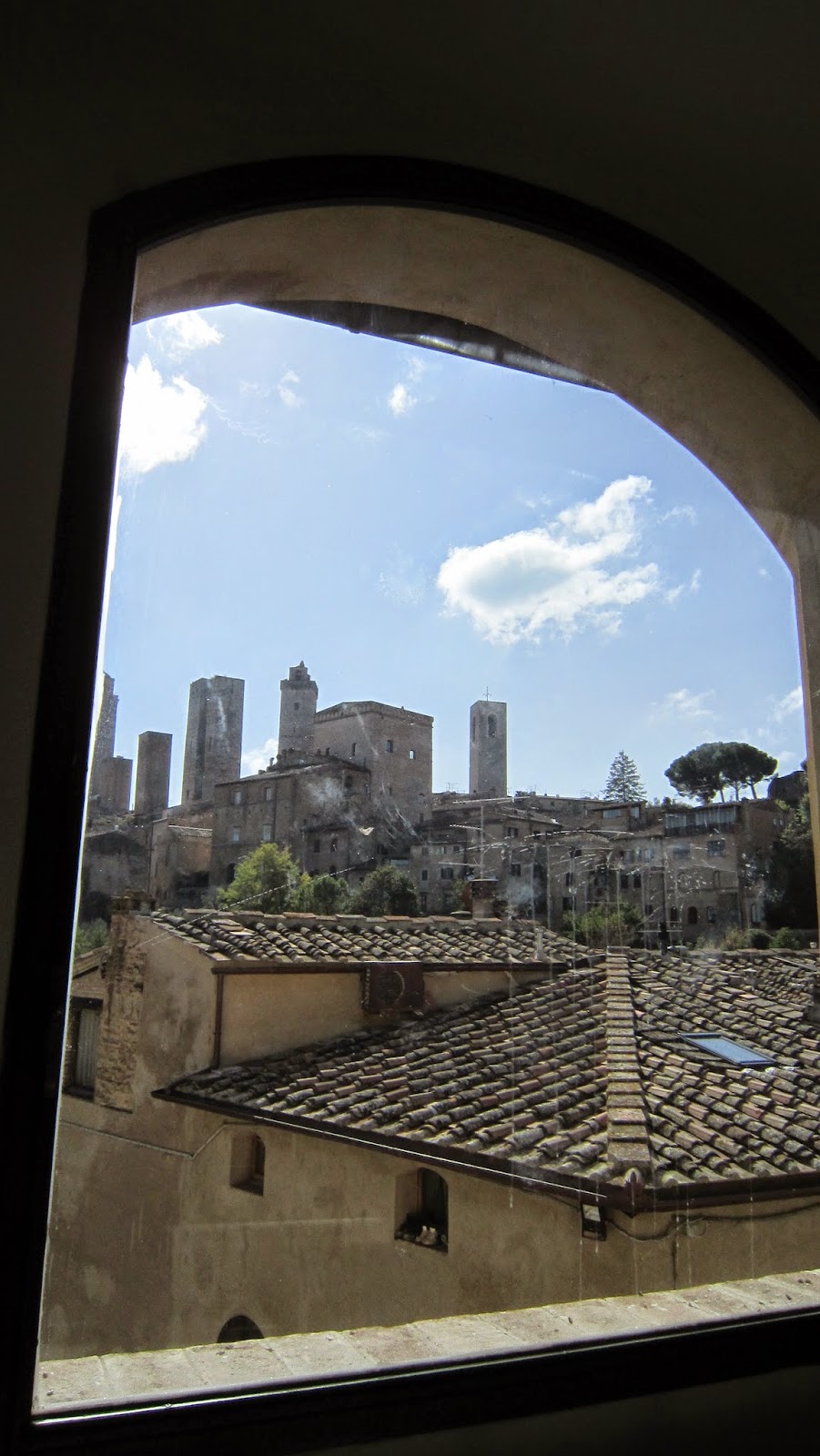
 By chance, I discovered one of the most dedicated medieval museums true to my heart! It was a hospital museum showing how herbal remedies were made and dispensed by the monastery for pilgrims and residents of this important stopping place. Actual books, so precious then, have been preserved with delicate drawings of herbs and directions for their use. The windows of the museum revealed a reconstructed herbal garden and an unparalleled view of San Gimignano's towers.


Urns full of herbs for remedies of all ills.


There are some remaining frescoes form medieval times to be found in the chapel of Saint Serefina who was born here in 1238. During the war years, these frescoes and others were saved from the withdrawing German army by the village women. A tall bell also rests on the floor near some delicate frescoes. During the Black Death plague of 1348, nearly half the population died, and the village remained preserved in its medieval state until the 19th century. My Tip: Best to arrive early, as the small village is inundated by tourists once the buses arrive!


View from the museum window.


Monday, 16 February 2015

Five unsung gems of Europe - Part 2

Moving around the countries of Europe by train and bus or ferry, we arrived at many destinations by the back door! My next gems are in Slovenia, which we approached by a magnificent train trip through the Alps from Salzburg. The first snow was dusting the peaks as we went by and many people complete with long poles and gear were setting off at various stations to walk the mountain trails. Slovenia has to be one of the most scenic countries, with its untouched beauty and splendid vistas from mountain lakes to medieval cities.


First snow of the season on the Austrian alps enroute to Slovenia.

Ljubljana: Every expectation I had of Ljubljana was met when we rolled into the station and commenced our short walk downtown to our accommodation in the central area. Foot friendly and welcoming, Lubljiana is famous for its 3 bridges, one of which the Dragon Bridge, was one of  the first arched concrete construction bridge in Europe during the time of the Austro-Hungarian Empire. It has many sheeted copper dragons along it and 4 above, the dragon being the symbol of Slovenia. The Triple bridge is also nearby. There are many beautiful churches including the cathedral to visit together with Ljubljana castle overlooking the medieval layout of the city. A funicular serves as a shortcut to the 12th century castle and Outlook tower, with a museum to visit and outdoor café to enjoy. While we were there, we enjoyed romantic dinners by the river serenaded by violins. There was also a festival with unusually tall human figures on stilts processing through the city. Art shops and bookshops delighted me as well! Ljubljana, truly a gem of modern Europe!


The mighty dragon symbol of Slovenia on Dragon Bridge.


Stilt walkers in downtown Ljubljana.


Triple Bridge, Ljubljana.


Looking across Lake Bled to the monastery.


Rowboats on Lake Bled.
From the monastery steps looking across the lake.
Lake Bled: We travelled the short distance by bus to Lake Bled for a day trip from Ljubljana. Words fail me here as there is nothing to compare with the untouched beauty of the lake which was revealed before us!  It is a tourist magnet that lives up to its reputation as powered boats are prohibited from using the lake environs. In fact, the European rowing championships are held here. The water is crystal clear and full of mirror images. To get to the monastery in the middle of the lake you can row yourself or like us be punted across by a willing  young man! We met up with many young people who come to pay their respects to their heritage in this way as the monastery is a significant site for them. There is a small museum and an eating area and  the whole island can be circled in fifteen minutes before returning. A magnificent castle that overlooks the lake can be visited too, or you can stroll like us around the lake enjoying the sunshine or having a cappuccino or vino or two at one of the many restaurants! Lake Bled, another true gem of Eastern Europe!


Sunday, 1 February 2015

Five unsung gems of Europe - Part 1

I don't profess to be the most knowledgeable world traveller, but over the past ten years, I have managed to pick up and learn of a few smaller and less well known  places that have delighted us! In keeping with our usual do our own thing itinerary using buses and trains throughout Europe, we have discovered the best tips come from locals and young people travelling cheaply, many a good time also had in passing - especially on "eat streets" and open air eating places!

Kayakers on the Vitava River


My first selection is Czechy Krumlov, a beautifully preserved medieval city on the Vitava River about an hour's train ride from Prague in the Czech Republic. It has a very large castle complex that dates back to the 13th century, overlooking the narrow alleyways of the village itself. The ornate ceilings and decorations take your breath away as you process through a chapel and onto large rooms typical of the biggest castles in Europe. It has a working stage machinery in a theatre that is one of the few operating still in the world. From here, you proceed down to the plentiful restaurants, cafes, even the Eggenberg brewery below and wander through the many interesting book and art shops.


View from the castle walls of the city.


After  a wonderful lunch in a very medieval, that is, suitably candle-lit!- restaurant, we were able to wander around before catching the bus and train back to Prague. You can watch from the bank, the kayakers fording the small rapids on the river that winds through the city, and investigate the churches and shops further. There are many festivals held here each year and the medieval tournaments , opera and summer music festivities would be well worth checking out!


Beside the Vitava River.

My tip: my advice is to stay the night, as we didn't and have regretted it ever since!


Monday, 26 January 2015

Daylight robbery!

Why did we fall victim to a robbery on a train from Patras to Athens in broad daylight?  There was only one person, admittedly a large male, on the train when we stood up to get off. We always cover each others backpacks and keep them in sight when travelling. He was very practised and very quick!


Luxury accommodation on board the ferry.

We had come overnight from Brindisi in Italy on the ferry and caught the train on landing in Greece, to go cross country. When buying the tickets, hubby got out his wallet and forgot to return it to his front pocket, easily done when tired! (Our money belts were securely on and I never carry a purse or wallet at all on overseas trips.) As soon as the train departed, and checking everything, we realised the wallet was missing. That horrible feeling comes over you, that feeling of disbelief, then the reality! Hubby had just received cash from the hole in the wall, to pay for the tickets as well! Worse still was the cards we lost, though we always had another with me.

The railway police were terrific, offering us the phone and helping us get through to numbers to cancel cards straight away. First question was, " From Australia! Do you know my cousin in Melbourne?" Surely do! However, we thought it a bit strange when they took us over the busy street to the police station and pointing it out, left us on our own! As our hotel, very budget friendly, was in this slightly run down area, we took our weekenders on wheels with us to get a statement for insurance purposes. Simple you would think? Wrong! It couldn't have been worse. We were holed up on the third floor of that awful cement building in the Athens intolerable heat, for hours of our afternoon. We had no food left, but luckily had water with us. Police officials kept squeezing past us with prisoners in line, in handcuffs... and no detective in that dingy, dark room wanted to bother with our little complaint!

 Finally, some ladies of the night, who were waiting with us on the stairs, took pity on us and through sign language , we managed to see the door open and hubby whipped his head in to get the scrap of paper required! My advice, do not commit a crime in Athens! The incarceration would be awful if our experience was anything to go by.....so saying, we had a wonderful time in this foot friendly city walking around the Parthenon and other ruins so close by!

The Parthenon, a spectacular monument to the might of ancient Athens!